
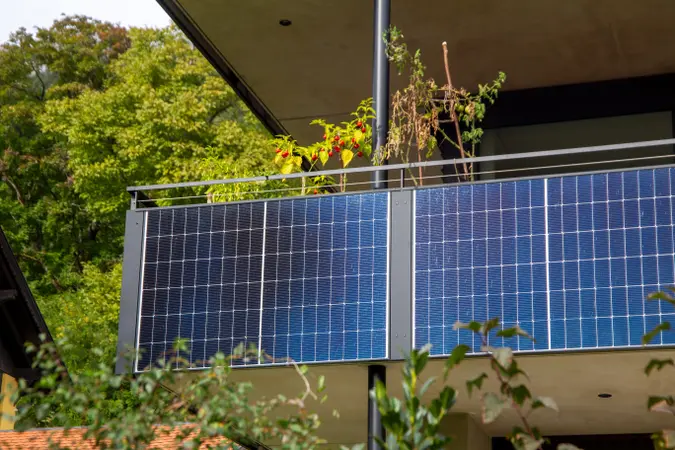
Ventajas de utilizar un elemento calefactor con una central eléctrica de balcón
Las centrales eléctricas para balcones son fáciles de implementar y, por este motivo, están en auge. ¿Pero qué podemos hacer con el excedente? ¿Un elemento calefactor es una alternativa a la producción de agua caliente en este sentido?
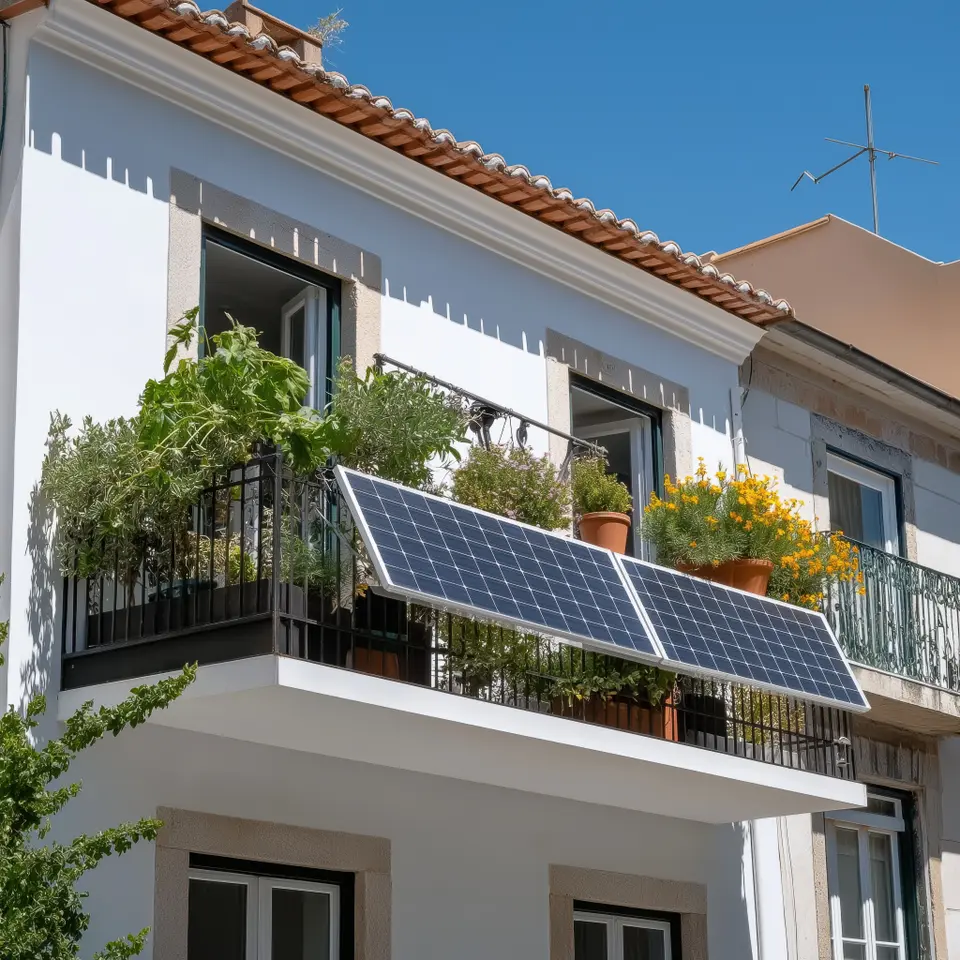
Las centrales eléctricas para balcones suelen ser pequeños sistemas fotovoltaicos que pueden tener como máximo 600 vatios (en Alemania) u 800 vatios (en Austria) de potencia de salida del microinversor. La conexión y el funcionamiento son simples, el ahorro de costes es fácil de calcular y la inversión, en comparación con un sistema fotovoltaico más grande, muy apreciable. No existen requisitos de registro o concesión, a menudo complicados, por lo que se trata de un método sencillo para reducir los costes de electricidad, incluso en apartamentos.
Autoconsumo de la electricidad de la central eléctrica de balcón
A diferencia de una instalación fotovoltaica conectada a la red de unos pocos kWp, en una central eléctrica de balcón no existe ninguna tarifa de alimentación con el operador de red, lo que significa que cualquier excedente que no se utilice directamente en el sitio pasa a la red pública sin coste.
¿Qué pasa si todos los consumidores de la casa disponen de una central eléctrica en el balcón y todavía queda un excedente?
Como es habitual en las instalaciones fotovoltaicas más grandes, un elemento calefactor podría calentar el agua caliente durante el día para aprovechar al máximo la energía solar. Sin embargo, en las centrales eléctricas para balcones, el excedente fotovoltaico disponible es prácticamente insuficiente o nulo para poder generar suficiente agua caliente.
Un pequeño análisis del potencial: una central eléctrica para balcones de 800 vatios proporciona aproximadamente 2 kWh de energía en un día soleado de primavera u otoño si el balcón está orientado al sur. En cambio, en una vivienda unifamiliar media, este rendimiento se absorbe casi en su totalidad en la carga básica de la casa y no queda energía para generar agua caliente.
La producción de agua caliente con energía fotovoltaica sigue funcionando
La central eléctrica para balcones (lamentablemente) solo puede considerarse como un alivio para los consumidores domésticos o para el suministro de la energía convencional. Para la generación de agua caliente, recomendamos utilizar adicionalmente o como alternativa, si el espacio lo permite, la variante aislada de la red de un elemento calefactor eléctrico solar, que se regula de forma continua. En lugar de un módulo de central eléctrica para balcones con microinversor integrado, se pueden utilizar de 4 a 8 módulos estándar con conectores MC4 y, con el dispositivo ELWA de my-PV, es posible utilizar corriente continua directamente para la generación de agua caliente sin inversor. También se puede utilizar la energía solar y sin autorización, ya que los módulos fotovoltaicos no están conectados a la red eléctrica pública, sino que se utilizan únicamente para calentar agua. El elemento calefactor continuo de 2 kW, nuestro ELWA, también tiene potencia suficiente para cubrir la producción de agua caliente únicamente con energía solar entre marzo y octubre. Puede consultar este ejemplo de referencia en Dinamarca.
Balcony power plants are usually small photovoltaic systems whose microinverters are allowed to deliver a maximum output of 800 watts (in Germany and Austria). Installation and operation are simple, the cost savings are easy to calculate, and the investment – compared to a larger PV system – is very manageable. The often complicated registration or approval requirements are eliminated, making balcony power plants an easy way to reduce electricity costs – even in apartments.
Using Electricity from the Balcony Power Plant Yourself
Unlike a grid-connected photovoltaic system with several kWp, balcony power plants are generally not eligible for feed-in tariffs from the grid operator. This means that any surplus electricity not consumed directly on-site is fed into the public grid without compensation – a nice bonus for electricity providers, but far less attractive for the owner.
In fact, the amount of energy effectively given away is considerable. In a typical two-person household with a 2 kWp balcony power plant – the maximum permitted module capacity – and an 800 W inverter, the system generates around 1,719 kWh per year. Without additional measures, as much as 1,031 kWh remains unused and flows into the public grid without compensation. Extrapolated to the more than one million registered balcony power plants in Germany alone, this represents an enormous amount of energy that is essentially being “gifted” to grid operators.
What Happens When All Appliances Are Supplied and Surplus Power Still Remains?
This is exactly where the untapped potential lies. As is common with larger PV systems, an immersion heater can heat domestic hot water during the day in order to make the best possible use of solar energy. A continuously variable power control ensures that every excess watt from the balcony power plant is directed specifically into the hot water tank instead of being wasted in the grid.
Calculations for a two-person household with a 120-liter hot water tank and an integrated 3 kW immersion heater clearly demonstrate the potential: with continuously variable surplus power control, around 972 kWh per year from the balcony power plant can be used for domestic hot water heating. This allows 47% of the annual hot water demand to be covered by solar energy, while grid feed-in drops from 1,031 kWh to only around 165 kWh – a reduction of approximately 84%.
Interestingly, a comparison with a 2 kWh battery storage system shows that a hot water tank can actually store more energy than a battery of this size. Combining battery storage with continuously variable hot water heating reduces grid feed-in to just 11 kWh per year – meaning that virtually the entire energy yield is consumed on-site. All details regarding the calculations can be found here.
Hot water with photovoltaics – even off-grid possible
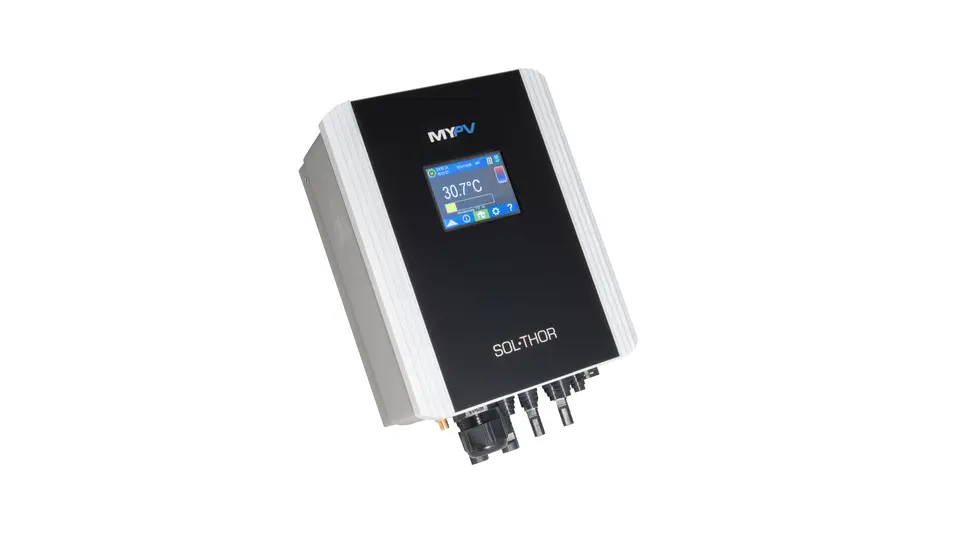
Provided there is enough space available, there is an especially elegant alternative or addition to a traditional balcony power plant: off-grid domestic hot water heating using a continuously regulated solar-electric heating element. Instead of a balcony PV module with an integrated microinverter, several standard PV modules with MC4 connectors are connected directly to a DC power manager – without an inverter, without a grid connection, and without any approval requirement!
With the my-PV product SOL•THOR, this can easily be implemented. The DC power manager converts solar energy directly and with virtually no losses into heat by supplying a heating element directly with PV-generated DC power. The result: solar energy can be used entirely without permits, because the PV modules are not connected to the public electricity grid and are used solely for domestic hot water heating.
Two reference projects demonstrate just how well this works in practice
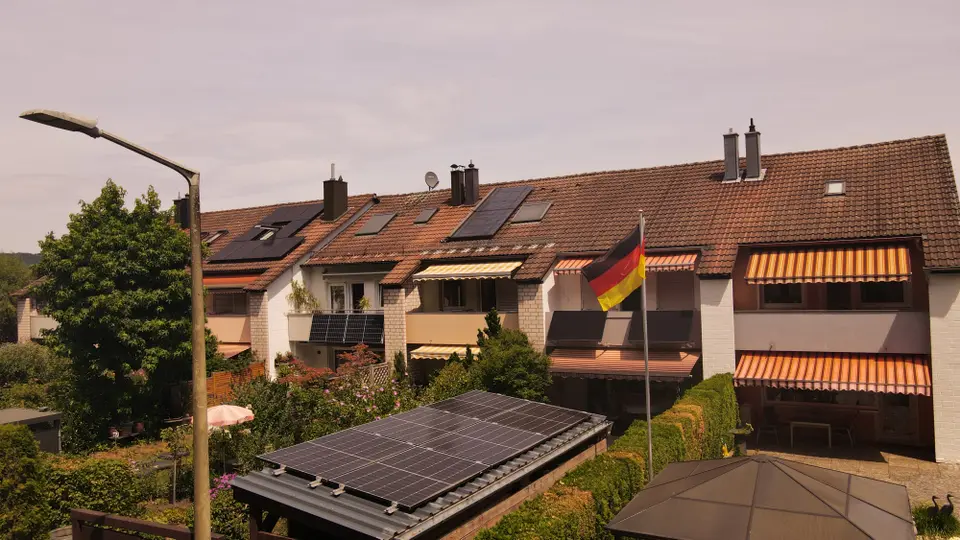
Townhouse in Nuremberg, Germany
How efficient an off-grid PV heating solution can be in real-life operation is demonstrated by a townhouse near Nuremberg. There, a 2.2 kWp PV system with just five modules has been supplying a 150-liter domestic hot water tank autonomously with solar energy since the beginning of 2025. The my-PV screw-in heating element is controlled via the SOL•THOR – without an inverter and without grid approval.
The estimated solar yield of 11 to 15 kWh per day during summer is more than sufficient to provide hot water for the two-person household. As a result, the oil-fired heating system is relieved on sunny days and heating oil is saved – because the heating system can remain switched off for several months.
Incidentally, the project was realized as a final thesis project by prospective mechanical engineering technicians at the Rudolf Diesel Technical School. The full reference project from Nuremberg can be found here.
To the Reference Description
To the Reference Description
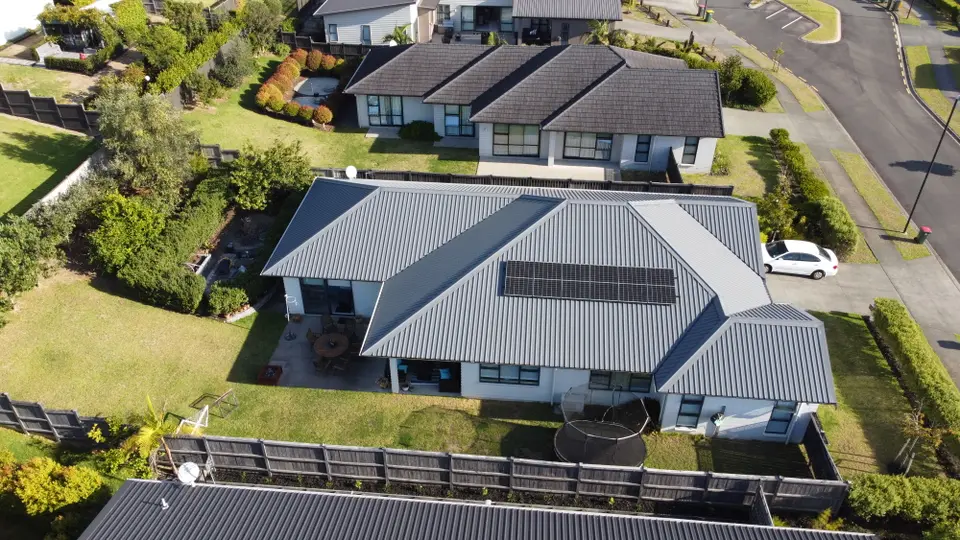
Single-family home in Auckland, New Zealand
A pilot project in Auckland demonstrates the potential of a slightly larger off-grid system combined with the SOL•THOR. In this installation, the SOL•THOR converts the electricity generated by a 2.7 kWp PV system directly into hot water using an existing 3 kW heating element in a 180-liter electric boiler. The PV array consists of six Suntech modules rated at 440 W each.
The results after more than one year of operation are impressive: of the annual domestic hot water demand of 4,072 kWh, 2,627 kWh are supplied directly by solar energy – corresponding to a solar coverage rate of around 65%.
The payback period for the SOL•THOR is approximately three years. The full reference project from New Zealand can be found here.
Conclusion: Heat unlocks the full potential of a balcony PV system
Whether as a grid-connected solution with continuously variable surplus control via the AC•THOR or as an off-grid variant using the SOL•THOR, domestic hot water heating with photovoltaic electricity is the key to unlocking the full potential of a balcony PV system.
Instead of feeding valuable solar energy into the public grid without compensation, the energy is used exactly where it matters most: within your own home.
Balcony PV System
for Hot Water
Use the surplus solar power from your balcony PV system not only for household appliances, but also for domestic hot water heating. Discover how my-PV can help you increase self-consumption, use energy more efficiently, and reduce the amount of electricity fed into the grid without compensation.
Learn more now!More articles
Empresa
my-PV refuerza su presencia en los Países BajosCon Frank van der Schaaf, my-PV amplía aún más sus actividades en el mercado neerlandés.
Leer más...
Socios
Nuevo socio de compatibilidad: EP Cube de Canadian Solar¡EP Cube de Canadian Solar, ahora compatible con la calefacción FV de my-PV!
Leer más...
Socios
Nuevo socio de compatibilidad Hoymiles¡Los inversores híbridos de Hoymiles ahora también son compatibles con las soluciones solares eléctricas de my-PV!
Leer más...